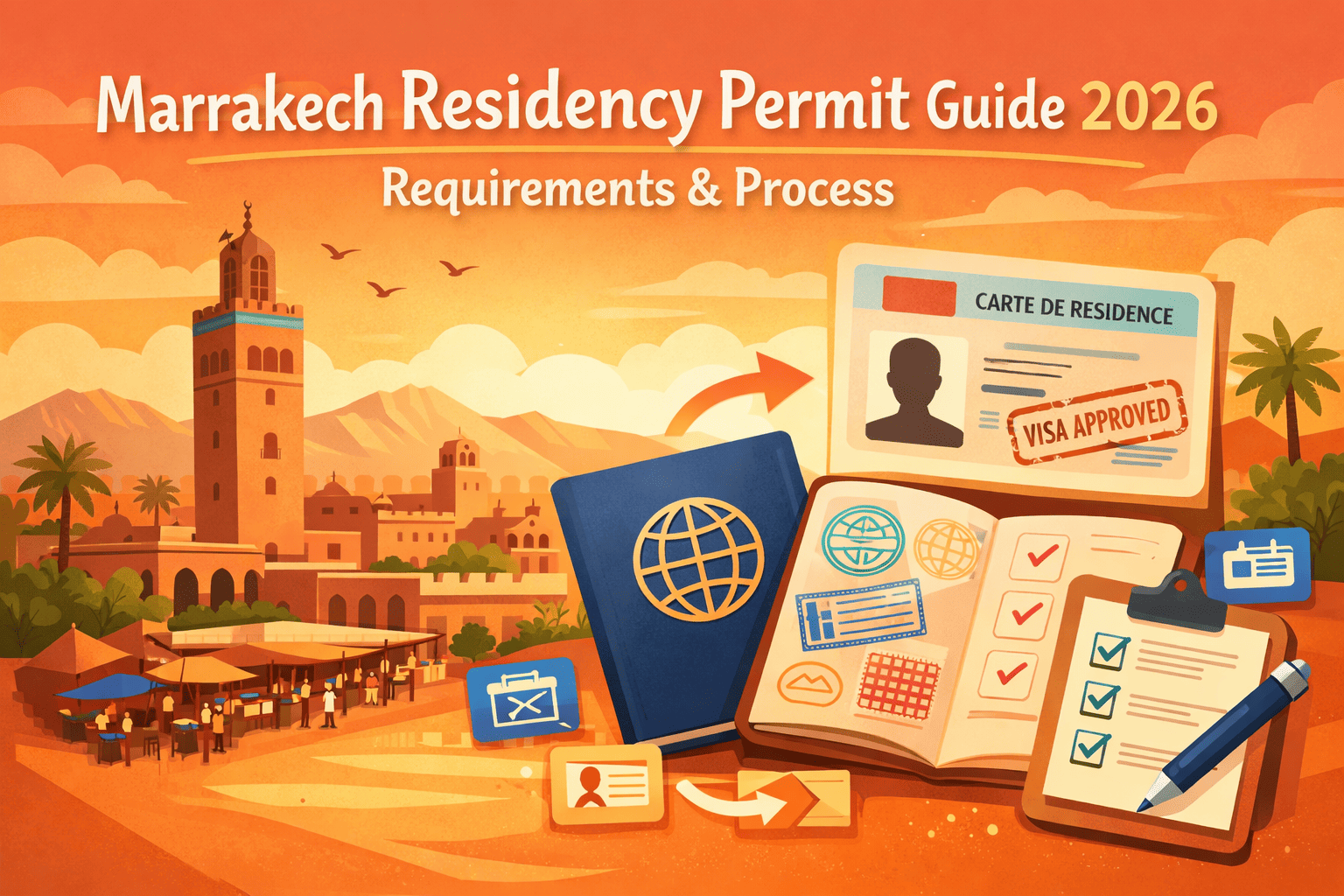
Marrakech Residency Permit Guide 2026: Requirements & Process
Obtaining a Marrakech residency permit is the key to enjoying the Atlas sun with full administrative peace of mind. This guide details the types of permit, the documents required and the key steps for settling successfully in Morocco.
Understanding Moroccan residency
Morocco offers several residence permits, each with its own conditions and validity period. The Direction Générale de la Sûreté Nationale (DGSN), through its Service des Étrangers, is the main authority governing immigration.
Types of residence permit available in Marrakech
- Carte d’immatriculation (the common “carte de séjour”): valid for one to ten years depending on the purpose of your stay, and renewable (Law no. 02-03, art. 10). It bears the mention “visiteur” for those living on their own resources, such as retirees, or the mention of the authorised professional activity. Be aware that it loses its validity if you leave Morocco for more than six months.
- Carte de résidence: it can be granted after at least four years of legal, uninterrupted residence (Law no. 02-03, art. 16). Valid for ten years and renewable, it is nonetheless not “permanent”: it lapses if you leave Morocco for more than two years.
- Property owners: the law provides neither a residence permit reserved for property owners nor an investment threshold. The certificate of ownership serves as proof of address, and you must show sufficient resources like any other applicant.
- Residency for retirees: Applicants must demonstrate a sufficient pension or investment income.
- Residency for investors or business owners: Creating local jobs can strengthen an application for those setting up a business in Morocco.

Requirements for a Marrakech residency permit
The conditions vary depending on nationality, permit type and personal circumstances. Always check the up-to-date list with the Préfecture de Police or the Commissariat de Police in Marrakech.
Essential documents checklist
- Valid passport: Must be valid for at least six months beyond your planned stay. Include copies of the main page and entry stamps.
- Completed application form (Demande de Carte de Séjour): The form is issued by the police (or gendarmerie) station your home address falls under.
- Proof of legal entry: Copy of your entry stamp or a valid visa. Most nationalities enter without a visa for 90 days, during which you must start the procedure.
- Proof of address in Marrakech: Certified rental agreement (contrat de location) or property title (titre de propriété) within the Marrakech prefecture.
- Proof of financial means: Essential for most categories. This can include bank statements, pension statements, business registration documents or an employment contract.
- Medical certificate: Issued by an approved Moroccan doctor, confirming the absence of contagious diseases.
- Criminal record extract: it is not on the official list published on Idarati, but some offices ask for it. If it is requested, have it translated into Arabic or French and apostilled (Morocco has applied the Apostille Convention since 2016).
- Passport photos: Usually four recent colour photos on a white background.
Applying for a Marrakech residency permit step by step
The application process is centralised but requires visits to several offices. Patience and organisation are essential for success.
Preparation before arrival
Gather the documents from your home country, in particular the criminal record check and proof of income. Have them translated into French or Arabic by a sworn translator. Have them apostilled before you leave if your country applies the Apostille Convention, as Morocco has since 14 August 2016; otherwise, have them legalised.
Legal entry and local registration
Enter Morocco legally. Secure your local address and obtain a certificat de résidence from your district authority (Caïdat or Pachalik) within the first few weeks.
To organise your move, see our guide on renting vs buying property in Marrakech. Understanding property law is essential for long-term planning; see our guide to Marrakech property laws.
Medical examination
Go to an approved medical clinic in Marrakech for the compulsory health check. The certificate is generally valid for three months.
Submission at the police station
Submit your complete file to the Service des Étrangers of the relevant police station, often at the Préfecture de Police de Marrakech. You will receive a receipt that may allow you to stay legally while your application is processed.
Interview and biometric data
You may be called in for a short interview. Fingerprints and a photograph will be taken for the card.
Approval and collecting the card
Processing times vary: the official Idarati portal states 30 days for the same procedure with the Royal Gendarmerie, but the wait can be longer. You will be notified to collect your Carte de Séjour after approval and payment of the stamp duty.
Costs and fees
Budget for official and incidental costs. Official fees are set by the Moroccan government and may change.
- Stamp duty: 100 dirhams (MAD) per year of validity of the residence permit, i.e. 100 MAD for a one-year card (General Tax Code, art. 252). This is the only official fee listed on Idarati, the national procedures portal.
- Document translation and legalisation: Variable cost. Budget 500 to 2,000 MAD.
- Medical examination: Usually 200 to 400 MAD at a local clinic.
- Notary and certification fees: May cost 100 to 300 MAD.
Total cost: excluding legal assistance, most of the budget goes on translations, legalisations and the medical certificate; the official fees are limited to the 100 MAD stamp duty per year of validity.
Common challenges and expert tips
Administrative procedures in a foreign language can feel daunting. These tips help smooth the path.
Overcoming language barriers
French is widely used in administrative settings. It is advisable to have your key documents translated into French. Consider hiring a local facilitator or a lawyer fluent in Arabic or French.
Official information is in Arabic or French: the Maroc.ma portal presents the institutions and online services, but does not detail the carte de séjour.
For reliable internet access during your procedures, consider Pocket WiFi Morocco.
Providing adequate proof of finances
No fixed minimum amount is published, but the authorities need to see a stable, regular income. Bank statements should show several months of history.
Find out more about the lifestyle in our complete guide to retiring in Marrakech. To gauge day-to-day costs, see our guide to tipping in Morocco.
Dealing with processing delays
Delays are common. Keep copies of all your documents.
The récépissé is your proof of pending legal status. It must be renewed every three months until a decision is made (Decree no. 2-09-607, art. 5): do not let it expire.
Renewing your residency permit
Start the renewal process 30 to 60 days before your card expires: the law sets the limit at fifteen days after the expiry date, beyond which you risk being escorted to the border. The procedure requires up-to-date proof of finances, a valid passport and sometimes a new medical certificate. Continuous residence is crucial for obtaining permanent status.
Life after obtaining your Marrakech residency permit
Your Carte de Séjour opens the door to deeper integration into Moroccan life.
- Opening a bank account: Much easier with a residence card. You get access to all banking services, including mortgages.
- Importing personal effects: Holders can import household goods duty-free under certain conditions. See Douane.gov.ma for the regulations.
- Access to healthcare: Private insurance is common, but long-term residents can explore the options under the AMO system.
- Driving: your foreign licence remains valid for at most one year from the date you settle (Law no. 52-05, art. 2). After that, you must either exchange it for a Moroccan licence, which is only possible with countries linked to Morocco by an agreement or by reciprocity, or take the Moroccan driving test.
- Exploring and leisure: With your residence card, make the most of the excursions. Discover the best day trips from Marrakech.
Frequently Asked Questions
How much does a residence permit cost in Morocco?
The only official fee is the stamp duty: 100 dirhams (MAD) per year of validity, so 100 MAD for a one-year card.
When must I apply for a carte de séjour after arriving in Morocco?
Most nationalities enter without a visa for 90 days, and you must start the procedure during that period.
Does buying property in Morocco give you a residence permit?
No. The law provides neither a residence permit reserved for property owners nor an investment threshold; the certificate of ownership only serves as proof of address.
How long does it take to get a residence card in Marrakech?
The official Idarati portal states 30 days for the same procedure with the Royal Gendarmerie, but the wait can be longer.
Can I drive in Morocco with my foreign licence once I live there?
Your foreign licence remains valid for at most one year from the date you settle. After that, you must exchange it for a Moroccan licence where possible, or take the Moroccan driving test.
Conclusion: your gateway to Marrakech
Securing a Marrakech residency permit demands careful preparation and patience. By understanding the permit types, gathering the required documents meticulously and following the step-by-step guide above, you considerably increase your chances of success. Discovering the best areas to live in Marrakech can help you find your ideal neighbourhood.
Ready to begin your journey? Check the official list of documents on Idarati, the national portal for administrative procedures (in Arabic), then confirm it with the Service des Étrangers at the Marrakech police prefecture.
For personalised support, contact a lawyer specialising in Moroccan immigration or a relocation specialist based in Marrakech. Explore more tips for choosing your long-stay base by reading our guide to long-stay villas in Marrakech. To discover the region before you settle, the official tourism portal Visit Marrakech presents what Marrakech-Safi has to offer.